The Disappearance of Rituals by Byung-Chul Han
Ritual as a unifying form of recognition, communication and completion
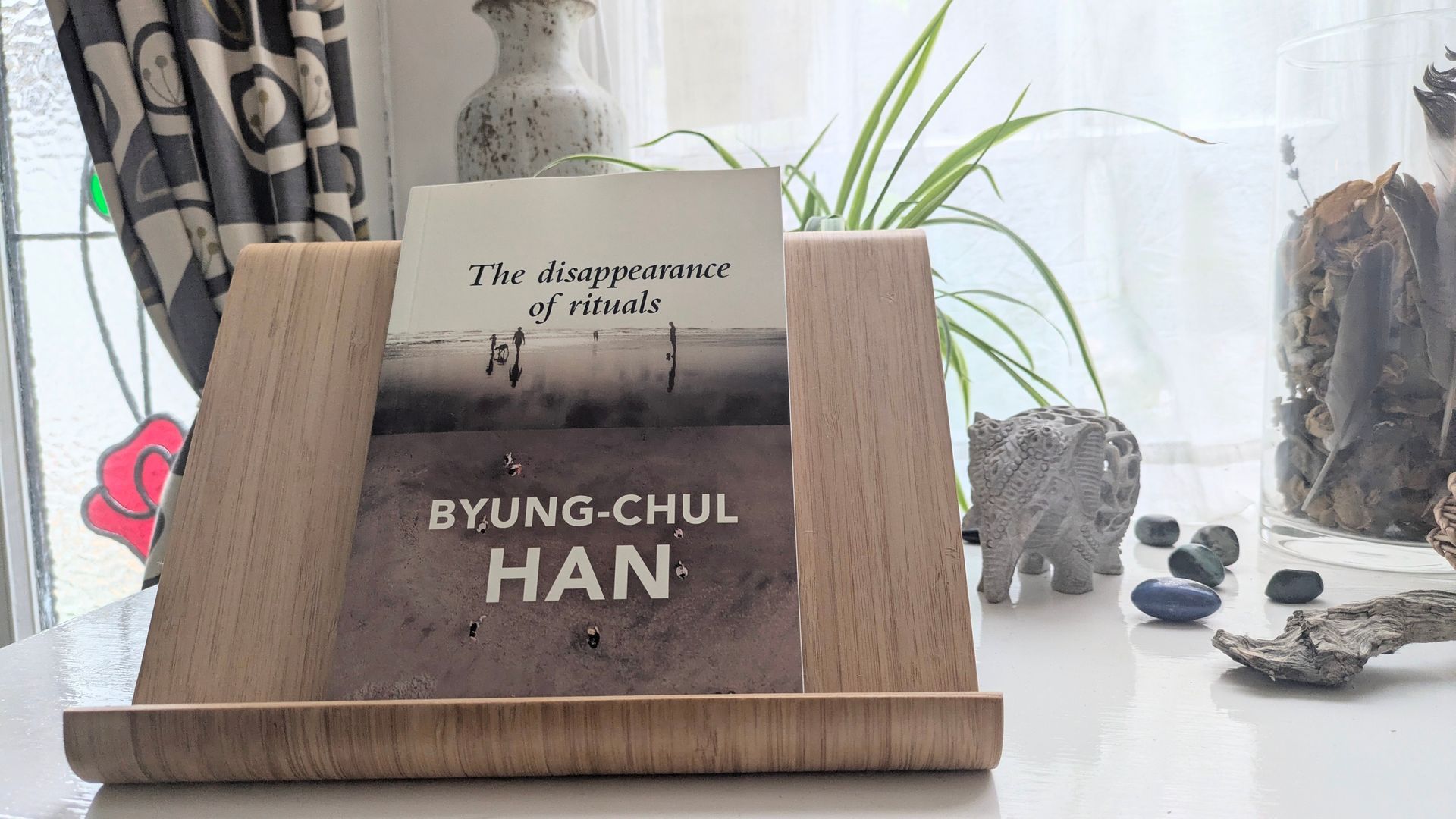
At a time of the progressive replacement of substance through communication, the relentless force of production has produced a twenty-first-century crisis of community. In his concise yet profound book, cited as a manifesto to addres untrammelled neoliberalism, Byung-Chul Han juxtaposes community without communication (achieved through togetherness and silent ritual) with communication without community (which leaves individuals exposed to exploitation and manipulation by neoliberal psycho-politics).
There are few books that challenge a reader to look further into the truth of the situation we find ourselves today which Byung-Chul describes as an atrophied and commodified community that lacks the symbolic power to bind people together. It is a truism that this can only be achieved through mutual recognition and the ritualistic sharing of the sybolic between members of a community. These are people who come together to engender collective feelings of togetherness as they honour the past and make sense of time.
As an antidote to the compulsion of perpetual production and meaningless data, Byung-Chul brings us back to the importance of symbolic ritual in forming symbiotic relationships where people support each other emotionally while still maintaining their own identity. A key part of this kind of relationship is recognition which is a perception of the permanent - the sense of knowing something as that with which we are already acquainted.
Recognition is how we make ourselves feel at home in the world. It implies we have come to know something authentically to form a perception of the permanent - a symbolic perception - that transforms being in the world into being at home. In a world shorn of contingency where all elements of chance, uncertainty or accidental circumstance are removed, the experience of durability diminishes. This is because data and information do not possess symbolic force and so do not allow for recognition.
Community without communication
The theme of this book is not driven by a desire to return to ritual per say. As Byung-Chul says, it is more that rituals serve as a background against which our present times may be seen to standout more clearly. There is no nostalgia here. This manifesto represents a study of families, lineages and family history over time, or rather the disappearance of such as we witness the ever increasing erosion of commununity in a society driven by collective narcissism.
Byung-Chul is a prominent professor at the Berlin University of the Arts who has written 30 books on modern society including The Burnout Society (see below) which I will be reviewing here in due course.
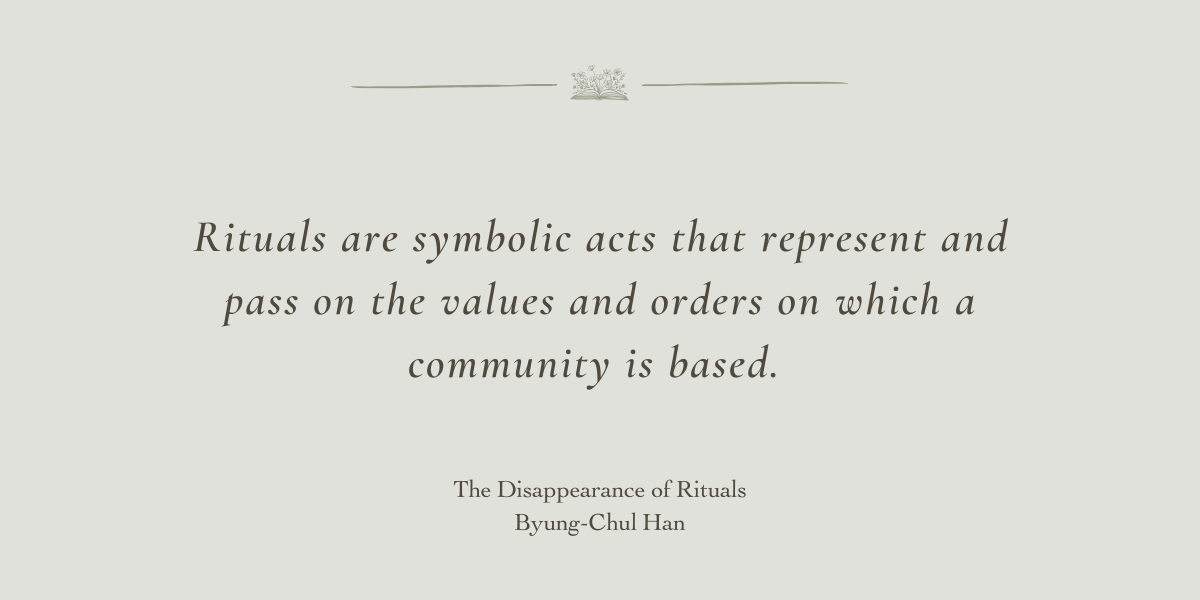
Community without communication is based on the fact that the durability of things have a function of stabilising human life. Rituals serve the same purpose. It is through their self-sameness and repetitiveness that they stabilise life. They make life last whereas the contemporary compulsion to produce robs things of their endurance.
As Byung-Chul says, it is the lingering that presupposes things that endure. This is something we can all practice, individually and collectively, as suggested in a review I wrote here about Pottering - A Cure for Modern Life by Anna McGovern. It follows that when things are merely used up and consumed, there can be no lingering. The compulsion of production destabilises life by undermining what is enduring in life. In a ritual context, things are not consumed or used up but used. It means they become old.
Communication without community
In direct opposition to symbiotic perception which is the perception of the permanent, data and information do not possess symbolic force and so do not allow for recognition. The images and metaphors that create meaning and community, and stabilise life, are lost in sybolic emptiness. Content displayed on a smartphone, for example, demands our constant attention and is therefore everything but self-same. The quick succession of bits of content displayed on the screen makes any lingering impossible.
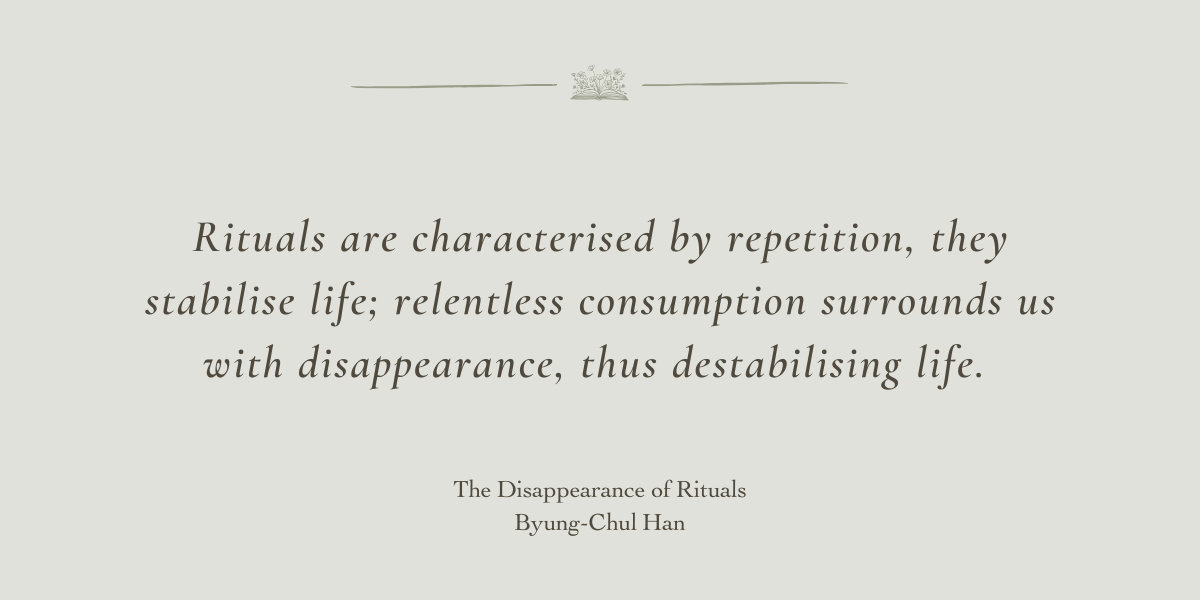
The way in which people reach for their smartphones is also compulsive. The restlessness inherent in the apparatus makes it a non-thing whereas forms of ritual, such as manners, make possible both beautiful behaviour among humans and a beautiful, gentle treatment of things.
Relentless consumption
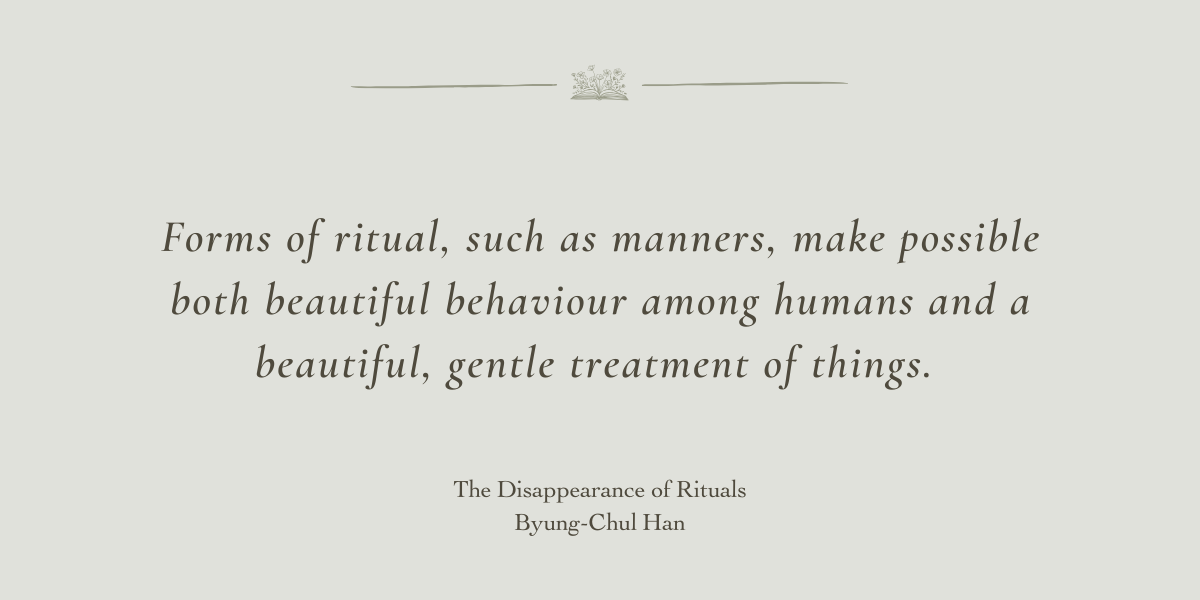
Byung-Chul makes the important point that in the compulsion of production, we behave towards things as consumers rather than as users. He reminds us that relentless consumption consumes us. It surrounds us with disappearance, thus destablising life.
Ritual practices ensure that we treat people and things in beautiful ways where there is an affinity between us and other people as well as things. When we consume things, we also consume the emotions that are ground up with things. This satisfies our search for emotional authenticity, however, the consumption of emotions strengthens the narcissistic relationship to ourselves. Our relationship with the world is thereby increasingly lost.
In addition, Byung-Chul identifies that values today serve as things for individual consumption. They become commodities where
values such as justice, humanity or sustainability are exploited for profit.
This is because neoliberalism often makes use of morality for its own ends where
moral values are consumed as marks of distinction.
They are credited to the ego-account where only the self is valued thus increasing a narcissistic self-respect.
The resonance of ritual
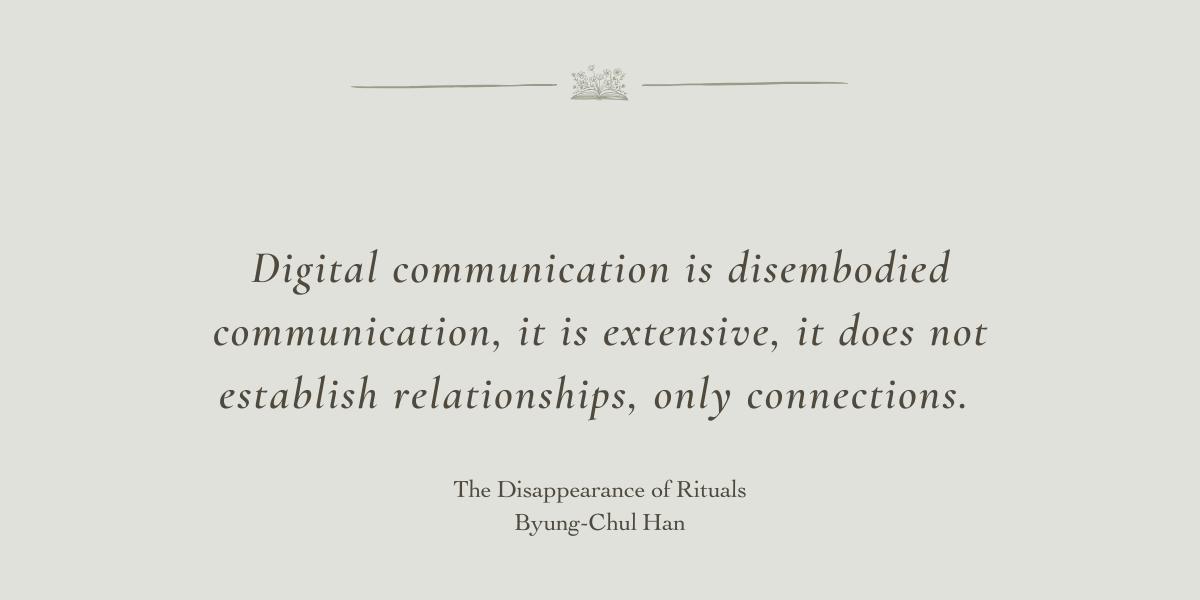
Rituals create resonance and a sense of accord and bodily connection. It is a lack of accord that causes disconnection and depression. This underpins today's crisis of community. It is where digitalisation exerts a disembodying influence, it weakens common ties resulting in disembodied communication.
There is a lot more to this book than covered here but the concept of community without communication compared to communication without community was of particular interest. It gives us the opportunity to gain a deeper understanding of the fact that digital communication is increasingly creating atomised communities that demand empathy and lack the symbolic power to bind people together.
It means it is up to us to resist the temptation of relentless consumption and reinstate the ritual community. This involves common listening and belonging, tacit agreement, play and collective consciousness. This can be achieved by adopting a more analogue way of life which fosters deeper interpersonal connections, reduces digital distractions and heightens in-person experiences and offline practices that help to combat loneliness and restore a sense of belonging.
Thank you for reading my review and I look forward to seeing you again soon.
Sue Cartwright
Spiral Leaf
Buy the book!
The Disappearance of Rituals by Byung-Chul Han
The Burnout Society by Byung-Chul Han
The Revenge of Analogue by David Sax
Clicking on the above link will take you to my online bookshop where Spiral Leaf may earn a small commission on books sold at no extra cost to you!
Thank you for sharing!
for you, for me and for Mother Nature
Latest Posts




All Posts